
Between Places of the Soul,
History, and Legend
INDEX
Pienza
Pienza is the perfect embodiment of the Renaissance “ideal city.” Nestled among the hills of the Val d’Orcia, it was commissioned by Pope Pius II and built upon the medieval village of Corsignano. It was transformed into an urban masterpiece that stands today as a symbol of the Renaissance and a UNESCO World Heritage Site.
Strolling along Corso Rossellino, Via dell’Amore, and Via del Bacio, you’ll breathe in a timeless harmony: noble palaces, romantic glimpses, panoramic terraces, and flower-filled alleys create a truly unique atmosphere. From Via del Casello and the viewpoint in Piazza Pio II, a breathtaking view opens onto the Val d’Orcia, where light and shadow dance across the golden hills. No visit would be complete without a taste experience: the intensely flavored Pecorino di Pienza pairs perfectly with a glass of Tuscan red wine. A place that enchants the senses—just 18 km from Vitalenta.


SAN QUIRICO D’ORCIA
San Quirico d’Orcia, a treasure chest of history and spirituality, owes its name to the young martyr Quirico, who was killed along with his mother Giulitta under Diocletian for their Christian faith. The village, of Etruscan origin, flourished thanks to the Via Francigena and welcomed Emperor Frederick Barbarossa in 1154—an event still commemorated each June with the Festa del Barbarossa. From 1559 onward, it came under the rule of Medicean Florence.
The architecture speaks of time: the Romanesque Collegiate Church, featuring works by Giovanni Pisano and Sano di Pietro; the elegant Palazzo Chigi; the Church of Santa Maria Assunta, possibly built over an ancient temple; and the “Horti Leonini,” an Italian-style garden that hosts the exhibition Forma nel Verde. A small sanctuary is dedicated to St. Catherine, while the castle of Vignoni watches over the landscape, reachable on foot through a path steeped in history and nature.
BAGNO VIGNONI
In Bagno Vignoni, in the heart of the Val d’Orcia, thermal water takes center stage. At the heart of the village lies the enchanting Piazza delle Sorgenti, dominated by a large 16th-century basin from which warm, steaming volcanic water flows, wrapped in an almost unreal stillness. As evening falls, amidst vapors and soft lights, the village transforms into a magical place—perfect for capturing photos that speak of poetry and silence. All around, spas and thermal pools offer moments of pure relaxation with views over the Tuscan countryside. Walking down the slope, you reach the Parco dei Mulini, where small thermal streams called gorelli invite you to dip your feet into the warm water. A glass of local wine in hand, steam rising in the air—at Bagno Vignoni, time slows down to make room for wonder.


Terme san filippo
The thermal baths of Bagni San Filippo offer an immersive and rejuvenating experience, blending nature and wellness. Surrounded by an enchanted forest, the sulfurous waters flow through natural pools and striking white limestone formations, including the famous “Balena Bianca” (“White Whale”)—a massive petrified waterfall that resembles the shape of a whale. Here, time feels suspended: steam mingles with the fresh air, water gushes from the springs at temperatures up to 48°C (118°F), and the landscape is painted in shades of white, blue, and the green of the surrounding vegetation.
Each season brings different emotions: between natural muds and relaxing baths, the waters gradually cool as they flow down the valley. An ancient thermal site known since Roman times and visited by Catherine of Siena and the Medici, Bagni San Filippo remains to this day a magical place where you can surrender to the warmth of the water and the silent embrace of the forest.
MONTALCINO
Perched on a hill in the Val d’Orcia, Montalcino overlooks golden vineyards and stands as the birthplace of the legendary Brunello—an iconic wine of elegance and passion. This medieval village, with its quiet alleys and ancient stone buildings, exudes a timeless charm. From the mighty Fortress, the view stretches across rolling hills and orderly rows of vines, while the Church of Sant’Egidio offers a peaceful moment of reflection. The Civic and Diocesan Museum holds memories of art and spirituality. But it is among the wine cellars that Montalcino reveals its deepest soul: here, Brunello is born from the land, the sun, and unwavering dedication. Taking part in a tasting or walking through the vineyards is a sensory journey—immersed in intense aromas, ancient flavors, and stories from the vine.
Montalcino is not just a place, but a journey through history, nature, and pleasure.


MONTICCHIELLO
Monticchiello, austere and poetic, reveals itself among the golden curves of the Val d’Orcia, just a few kilometers from Pienza. In spring, the fields burst with poppies and wheat, offering picturesque views to capture. The village, enclosed by mighty walls and ancient towers, preserves the soul of a distant time. Walking through the stone alleys, your gaze wanders over the valley, and every corner tells a story: look for the “Head of the Traitor,” a medieval bas-relief that tells of a castellan who, for two thousand florins, opened the village gates to the Florentine enemies. At the top of the village stands the Gothic church of Saints Leonard and Christopher, silent guardian of the Madonna and Child by Pietro Lorenzetti.
Monticchiello is an untouched treasure chest of the past. Here, every stone, every view, every breath carries the echo of an authentic and timeless Tuscany.
MONTEPULCIANO
Montepulciano, suspended between the Val d’Orcia and Val di Chiana, enchants with its Renaissance elegance. Of Etruscan origin, the village also flourished during the Lombard and medieval eras, contested by Siena and Florence for its wealth. Perched at 605 meters, the “Pearl of the 1500s” is a maze of stone alleys, artisan shops, and views that open onto an endless landscape. Passing through Porta al Prato, you walk through the heart of the village to Piazza Grande, dramatic and solemn, dominated by the Cathedral and the Town Hall with its Gothic tower. Just below the walls, the Temple of San Biagio rises harmoniously among cypress trees, inspiring Michelangelo in designing the plans for St. Peter’s Basilica in Rome.
Montepulciano is also a land of wine: the Vino Nobile, a full-bodied and deep red, can be tasted in the historic cellars carved into the tuff. Today, walking among its stones is like flipping through a history book, immersed in pure beauty.

LUCCIOLA BELLA
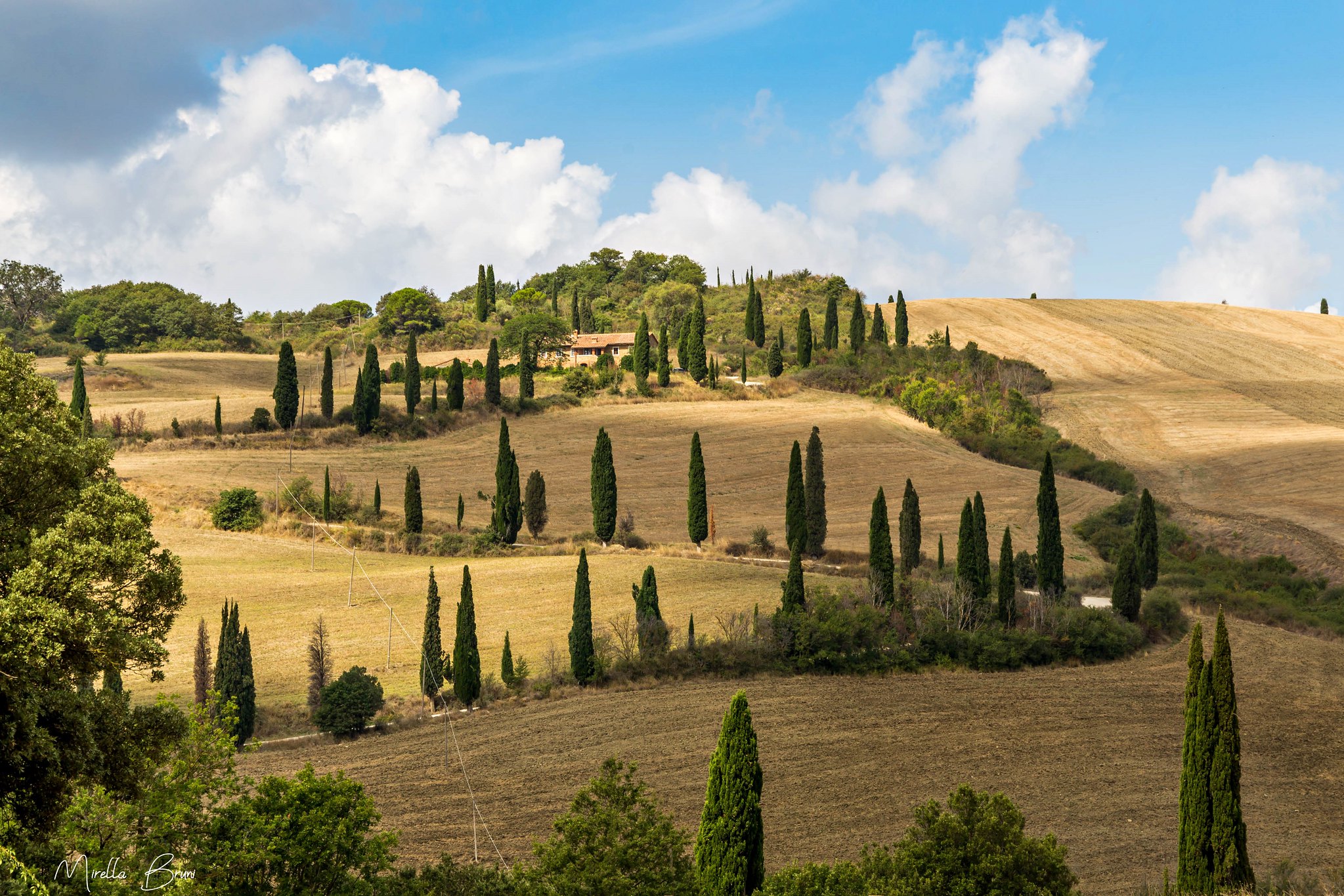
Lucciolabella Nature Reserve is an enchanted place in the Val d’Orcia where nature becomes poetry. Among gentle hills and clay formations sculpted by the erosion of the Orcia River, the landscape takes on an almost lunar appearance. Here, broom and juniper plants color the fragrant air with gold and green, while silent paths wind through woods and ravines. Walking in this setting is a rejuvenating experience: you might catch sight of roe deer or wild boars in the distance and come across rare plants like sea barley and wormwood. The clays, millions of years old, still yield fossils from a time when the whole area was an ocean. Rising towards La Foce, your gaze opens to one of Tuscany’s most breathtaking views: the famous Cypress Road, an eternal icon of the Val d’Orcia. Here awaits Vitalenta, where every snapshot becomes a postcard.
Chapel of the Madonna di Vitaleta
Among the gentle hills of the Val d’Orcia, between silent cypress trees and golden fields, stands the Chapel of the Madonna di Vitaleta—a poetic vision set within the landscape. Solitary and harmonious, it is one of the most beloved and photographed places in Tuscany, a symbol of essential and timeless beauty. Accessible by a short walk along a dirt road between San Quirico d’Orcia and Pienza, the chapel appears suddenly, discreet and perfect. At sunset, the warm reflections of the sky caress the stone, creating a suspended, almost sacred atmosphere. A UNESCO World Heritage Site, it is more than a building: it is a moment of peace in a landscape that seems to have emerged from an ancient dream.


Abbey of Sant’Antimo
Surrounded by the silence of vineyards and the echoes of history, the Abbey of Sant’Antimo stands solemnly among the Tuscan hills, just a few kilometers from Montalcino. A Romanesque masterpiece from the 9th century, built of golden stone and marble, it captivates with its architecture: rounded arches, elegant colonnades, and a simple yet perfect façade. Crossing its threshold, you enter a suspended world where light filters through the naves and the characteristic Gregorian chants of the Benedictine monks create a sacred and solemn atmosphere.
Around it, fields of wheat and rows of vines shape a harmonious landscape, ideal for reconnecting with oneself. Sant’Antimo is not just a place to visit, but to experience slowly, listening to the passage of time and the spirituality that still dwells here today.
RADICOFANI
Radicofani, a charming medieval village at the foot of Monte Amiata, is linked to the legendary figure of Ghino di Tacco, the “Tuscan Robin Hood” celebrated by Dante and Boccaccio. A rebellious Ghibelline, he turned the Fortress into an impregnable refuge from which he launched his raids as a noble thief along the Via Francigena. The Fortress, built in the 1200s, dominates the Val d’Orcia with its imposing tower. Inside, it houses the Cassero Museum with Etruscan and Renaissance artifacts, underground passages, and medieval bastions.
Among the alleys, you’ll discover the Church of San Pietro with terracotta artworks and a Madonna and Child by Valdambrino. Just beyond, the Church of Sant’Agata and the Palazzo Pretorio tell the ancient soul of the place. Don’t miss the Palazzo della Posta, a Medici villa and refuge for illustrious travelers. For a moment of tranquility, the Isabella Woods welcomes visitors with its romantic and esoteric spirit. Radicofani is history, charm, and legend.

HOSPITALITY
A Tuscan retreat to immerse yourself in
Vitalenta welcomes you into its suites, where rest becomes a journey. Each room holds a different story, and every detail is chosen to tell a fragment of a past life reborn in new forms. A past that returns to the present, united by a single gaze: the one towards the Tuscan hills.

ADDRESS
Loc. La Foce,
Pienza (SI), 53026
CONTACTS
CIN: IT052021B5I2W76K2D - Copyright @2025 vitalenta agriboutique